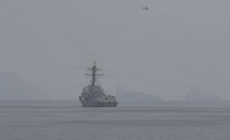
A Chinese ship that appeared to have successfully exited the Strait of Hormuz on Wednesday is now back in the Persian Gulf after failing to bypass a blockade set up by the U.S. Navy, which said it turned back six vessels in the first 24 hours of the operation.
The Rich Starry, a chemical and crude oil carrier sanctioned by the U.S. government in 2023 for trading with Iran, was among over half a dozen vessels that attempted to cross the strait on the first day of the blockade, ship-tracking data showed.
Why It Matters
The U.S. Central Command, also known as CENTCOM, said the blockade, which began at 10 a.m. Eastern Time on Monday, was being “enforced impartially against vessels of all nations entering or departing Iranian ports and coastal areas.”
“During the first 24 hours, no ships made it past the U.S. blockade and 6 merchant vessels complied with direction from U.S. forces to turn around to re-enter an Iranian port on the Gulf of Oman,” it said in a post on Tuesday.
Vessel traffic through the Strait of Hormuz is less than 10 percent of its pre-Iran war average of about 138 transits per day, with the blockade—and the potential for Iranian retaliation—adding more uncertainty for shipping lines and their insurers, despite U.S. calls to return to business as usual.
CENTCOM did not immediately respond to a written request for comment on the movements of the Rich Starry.
What To Know
The Rich Starry, owned by Shanghai Xuanrun Shipping, was carrying 250,000 barrels of methanol from the United Arab Emirates and was bound for Oman, according to the commodities analytics firm Kpler.
However, transponder signals captured by the Kpler-owned vessel-tracking website MarineTraffic showed the ship had navigated north of the strait as it made its eastbound journey, pointing to its possible use of an Iran-declared transit corridor through Iranian territorial waters.
Kpler said the transit regime reroutes inbound and outbound traffic around Larak Island, which hosts an Iranian military outpost responsible for vessel and cargo verification and clearance. Tehran charges users $1 per barrel of liquid cargo, “payable on exit from the Gulf, reportedly in cryptocurrency,” its analysis said.
President Donald Trump said on his Truth Social platform on Sunday: “No one who pays an illegal toll will have safe passage on the high seas.”
Shanghai Xuanrun Shipping could not be reached for comment after hours.
Newsweek’s review of automatic identification system, or AIS, data on MarineTraffic showed the Rich Starry was broadcasting “China owners and Crew” when it began its voyage out the strait on Tuesday, having previously aborted an attempt the day before.
The vessel reached the Gulf of Oman but turned back shortly after. As of Wednesday morning, it was signaling its location off Iran’s Qeshm Island in the Persian Gulf.
It was unclear whether the Rich Starry was carrying any Iranian oil during its voyage.
The TankerTrackers.com shipping intelligence company said in a post on Tuesday: “Her AIS signals make you believe that RICH STARRY (9773301) is laden with refined products from the UAE but she is actually a serial AIS spoofer and a designated sanctions violator with a history of transporting Iranian refined products.”
The International Maritime Organization, a U.N. specialized agency, assigns an IMO number to each vessel, which it retains throughout its service life even as its owners change its name.
The Rich Starry’s IMO is 9773301. It was formerly known as the Full Star.
The China Factor
The U.S. blockade—an operation involving 10,000 American service members—could put the U.S. and China at odds if its undermines Chinese economic interests in the region.
China secured half its crude oil from the Gulf states last year, including undeclared Iranian product accounting for around 10 percent of its annual imports, according to estimates by Kpler. Over 90 percent of Iran’s crude exports go to Chinese refineries.
Beijing pressured Tehran into talks with the U.S., which led to the two-week ceasefire announced earlier this month.
The Chinese economy has been spared amid the Middle East war thanks to Beijing’s stockpile of oil and gas. But its supplies could run low if the conflict is prolonged or expands.
On Tuesday, Treasury Secretary Scott Bessent called China an “unreliable partner” for holding on to its oil instead of helping to ease the global shortage caused by Iran’s weeks-long closure of the Strait of Hormuz, through which one-fifth of oil and gas flows.
Earlier the same day, China’s Foreign Ministry called the U.S. blockade “a dangerous and irresponsible move” that would “undermine the already fragile ceasefire and further jeopardize safe passage through the Strait of Hormuz.”
Trump is scheduled to visit China next month for a first U.S. state visit to the country since 2017, under the first Trump administration.
What Happens Next
Trump said on Monday that the U.S. and Iranian delegations could meet again this week for another round of peace talks following the failed opening round in Pakistan over the weekend.
“The top priority is to make every effort to avoid the restart of the war, maintain the hard-won momentum of the ceasefire and insist on resolving disputes through political and diplomatic channels,” Guo Jiakun, China’s Foreign Ministry spokesperson, said at a regular press conference on Wednesday.
Iran could take one of three options in response to the U.S. blockade, including cutting a deal with the U.S. that likely would see it give up its nuclear program, according to the Institute for the Study of War, a Washington think tank.
“Iran could attempt to run the blockade, a move that would almost certainly result in a U.S. response and possibly the seizure of Iranian vessels central to Iran’s oil trade,” it said in new analysis on Wednesday.
“Iran could restart or widen the conflict, although it is unclear whether a resumption of the conflict would necessarily end the U.S. blockade on Iranian ports,” the ISW said.
A U.S. Navy destroyer stopped two oil tankers attempting to leave the Iranian port of Chabahar on Tuesday and instructed them to turn around, Reuters reported on Wednesday.
“An estimated 90% of Iran’s economy is fueled by international trade by sea. In less than 36 hours since the blockade was implemented, U.S. forces have completely halted economic trade going into and out of Iran by sea,” CENTCOM leader Admiral Brad Cooper said in a statement late on Tuesday.
In a Truth post early on Wednesday, Trump shared analysis titled: “Iran could run out of oil storage with Trump blockade, wreaking havoc with its economy.”