A highly mutated COVID-19 strain is circulating in California — raising concerns that disease activity could rise heading into the summer.
The emergence of the BA.3.2 strain, nicknamed “Cicada,” comes amid broader uneasiness about COVID vaccination rates among seniors — who are especially susceptible to the virus — and whether complacency after back-to-back relatively quiet winters has left the elderly vulnerable. The “Cicada” nickname refers to this subvariant’s apparent dormancy before it reemerged in 2025, akin to some periodically active insects of the same name.
The timing of the spread of the Cicada subvariant also underscores that COVID has lately morphed into more of a summer disease in California. In fact, the summer peaks of COVID in 2024 and 2025 were worse than their respective winter peaks, according to the California Department of Public Health — a stark departure from the earlier years of the pandemic, when winter surges ripped through California with devastating regularity.
Instead it was the flu that was the dominant respiratory virus the last two winters, with this past season considered moderately severe.
“This Cicada variant may be increasing just in time for what for COVID is more of a summer hit,” said Dr. Neil Silverman, director of the Infections in Pregnancy Program at the David Geffen School of Medicine at UCLA. “COVID doesn’t seem to play by the same rules that influenza tends to play by, where its cycle is predictable.”
Dr. Peter Chin-Hong, a UC San Francisco infectious diseases expert, said Cicada is “a different kind of variant that’s increasing. It looks so different from the other ones that have been circling since JN.1 came on board” in late 2023.
“My ears are perking up,” he said.
In lab studies, the Cicada subvariant efficiently evades immunity from a prior vaccination or infection, according to a report published by the U.S. Centers for Disease Control and Prevention. That raises the possibility of a seasonal increase in COVID-19, the researchers said.
“Although widespread infection- and vaccine-conferred immunity have decreased rates of severe COVID-19 over time, the public health impact of COVID-19 is still considerable,” scientists recently wrote in the CDC’s Morbidity and Mortality Weekly Report.
During the 2024-25 respiratory virus season, there were an estimated 45,000 to 64,000 COVID deaths and 390,000 to 550,000 hospitalizations.
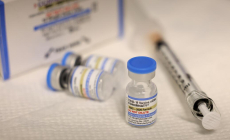
A potential uptick is concerning as recent COVID vaccine coverage remains scant — even among the most vulnerable Californians. Statewide, just 28.7% of seniors age 65 and up have received at least one dose of the COVID vaccine that was updated in September.
The California Department of Public Health recommends that everyone ages 6 months and up should have access to the vaccine, and that those at higher risk of severe illness should get immunized — including older adults, pregnant women and infants and toddlers. The same goes for healthcare workers, residents of long-term care facilities and people who have household members at high risk.
People at higher risk for COVID-19, including seniors and those who are immunocompromised, should get two doses of the updated COVID-19 vaccination, spaced six months apart, state health officials said in a briefing to health professionals.
“To me, the biggest threat … is the low vaccination rate in seniors,” Chin-Hong said. “The landscape of divisiveness around vaccines is leading people to be confused and to think of COVID as being political when it’s not.”
The Cicada subvariant was initially detected in South Africa in November 2024, and first found in the U.S. in a sample given at San Francisco International Airport in June 2025 by an international traveler from the Netherlands.
By that September, detection of the subvariant was increasing. In November, BA.3.2 was identified in a wastewater sample in Rhode Island; and among patients, the first detections of the new subvariant were found in three different states in December and early January.
As of February, the Cicada subvariant has been reported in 23 countries, and has also been seen among airline passengers to the U.S. traveling from the United Kingdom, Japan and Kenya. Over the autumn and winter, about 30% of coronavirus samples analyzed in three European countries — Germany, the Netherlands and Denmark — were the Cicada subvariant, according to the Morbidity and Mortality Weekly Report.
It’s not a surefire bet the Cicada subvariant will bring a summer of misery, however. COVID wasn’t appreciably worse this past winter than in previous years in central Europe.
According to the California Department of Public Health, the Cicada subvariant remains at low levels in the state’s wastewater, and there have been no reports of increased severity of illness among those who were infected. It’s also not projected to be a particularly fast-growing subvariant, nor a dominant one.
The last time the Cicada subvariant was detected in one public database, it represented about 5% of samples identified in U.S. wastewater for the week of March 28, according to Alexandria Boehm, professor of civil and environmental engineering at Stanford University and principal investigator of WastewaterSCAN, which monitors sewage to track the presence of infectious diseases.
During the first week of April, though, the Cicada subvariant was not detected, and all the samples were of another COVID strain, XFG, according to Boehm.
It’s notable that concentrations of the coronavirus in wastewater have been relatively low and, as a result, “it is hard to obtain high-quality, high-confidence sequences,” Boehm said.
In slides prepared for a recent briefing of medical professionals, California health officials forecast a potential modest wave of COVID in the late summer and early fall.
Chin-Hong likened it to a weather report.
“The clouds are coming, and you might get a downpour, or it might just pass on. We don’t really know, but it just gives us some pause,” he said.
Chin-Hong urged seniors who haven’t gotten the COVID vaccine in the last 12 months to do so. “Getting it once a year as a senior is going to be really important,” he said.
Data continue to show that the COVID vaccines are safe and effective, and protect both pregnant women — who are susceptible to more severe disease should they get infected — and their newborns, Silverman said. Of infants up to 6 months of age who were hospitalized with COVID, nearly 90% were born to women who had no record of vaccination against COVID during pregnancy, according to a report published by the CDC.
Getting vaccinated also lowers the risk of long COVID, “and the more times you get a COVID infection, the higher your risk of ultimately developing long COVID,” Silverman said.
“COVID is still here. People can’t necessarily take comfort from the fact that we did not have a surge over this past winter. And we need to be anticipating the possibility that this variant may be more of an issue in the summer and early fall,” Silverman said.